




Headphone safety
Can earphones really damage your hearing?
 Compared to giant PA stacks and studio monitors with 15
inch drivers, headphones or earphones
look small and harmless. But what matters is how
much the sound makes your eardrums vibrate.
In fact, most earphones
can produce a louder sound at the eardrum than all but the largest and
most powerful studio monitoring loudspeakers, and can easily give noise
exposures well above the accepted safety limits.
Compared to giant PA stacks and studio monitors with 15
inch drivers, headphones or earphones
look small and harmless. But what matters is how
much the sound makes your eardrums vibrate.
In fact, most earphones
can produce a louder sound at the eardrum than all but the largest and
most powerful studio monitoring loudspeakers, and can easily give noise
exposures well above the accepted safety limits.
Unfortunately there are a couple of extra danger factors that make it even more necessary to take care:
Earphones don't sound as loud as loudspeakers when the sound level at the eardrum is the same. To sound as loud as loudspeakers, the amount that earphone level has to be turned up is typically 6 dB - that's four times the power.
(This may happen because the brain isn't fooled into thinking the sound is "out there" - it can work out that that the music is right next to your head and so expects it to sound loud.)
Earphone listening is private. With loudspeakers, if you listen at a very high level, it will usually be obvious - eventually the neighbours will complain! With earphones, people can get an excessive dose of sound without themselves or anyone else realising it.
You can't assume that equipment made for the domestic market will be safe for professionals who might have to do a lot of listening. A 2010 survey found that an iPod Nano set on maximum volume, using the standard ear-buds, produced a one-hour average sound level of 96 dB with a popular album.
Do speech and music affect hearing differently from industrial noise?
Many people find it difficult to believe that listening to music can be a hazard to hearing. But there's little evidence that loud music, however harmonious, is actually safer than unpleasant noise that would measure the same on a sound level meter. Even those who argue that music is safer than other noises would agree that if it is loud enough, and repeated often enough, music can damage hearing.
So far as the law protecting people at work is concerned, loud music or speech is just another hazardous noise. So when people are working with reproduced sound, safety must be taken seriously.
Speech on earphones can give an excessive noise dose, just as much as music. This can happen where people such as telephone operators listen for long periods every day. Another particularly difficult situation is where people have to understand speech in high levels of background noise. In this case it is vital to use good noise excluding earphones, but even with these you have to protect against excessive noise exposure.
Measuring sound level from your earphones or headphones
We measure sound level from earphones for health and safety purposes, using the method specified in ISO 11904-2.
This requires a different technique from more usual sound level measurements. If you tried to measure the sound level from earphones with an ordinary sound level meter, you could get very different answers depending on exactly where you put the microphone - and very likely none of them would be right!
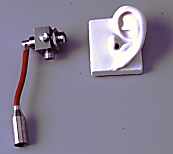
An earphone coupler, with microphone
and artificial outer ear
To measure an earphone properly, you have to put it on or in, an ear! Real ears vary between individuals, so in practice we use a standard artificial ear, called a coupler. This incorporates a microphone, which measures the sound level in a position corresponding to the eardrum in a real ear.
The coupler corresponds to the part of the ear inside the head - from the end of the ear canal inwards. This is enough for insert earphones, but headphones also need the outer ear and head surface. For these, the most practical solution is to use the coupler together with the head part of an acoustic manikin, commonly known as a "dummy head". The dummy can then "wear" the headphones.
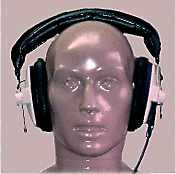
Acoustic manikin
Even this measurement needs to be corrected. A production line worker, standing in a steady 95 dB(A) factory noise, would probably have a much higher sound level at his eardrum - depending on the frequency of the sound, possibly 105 dB(A) or even more. This is because the outer ear and ear canal act as an efficient collector and amplifier of sound. For a fair comparison between sound from earphones and sound measured in rooms, we must correct for this amplification - which is not the same at all frequencies. This, finally, gives a figure that can be correctly compared with sound levels measured in the usual way. (The figure I gave above for an iPod Nano has been properly corrected.)
Who is most at risk from excessive sound level on earphones?
-
People who have to listen in a noisy environment, whether they are factory workers, sports commentators having to hear above the noise of a crowd, musicians trying to hear a backing track against the sound of a rock band, or camera operators trying to hear talkback at a live music event.
-
DJs and other performers. They may feel they "need" to hear music loudly because it gives them the buzz that helps them to do their job, or maybe they just like it loud. Maybe, even, they already have some noise-induced hearing loss - but unfortunately this doesn't protect against further damage.
-
People who have to listen on earphones for most or all of every working day, such as people working in call centres, or those working in the media who need to select or review material for programmes.
How can I protect against high sound level from earphones?
There are three main ways to make sure earphones are safe. Either
-
Restrict the power of the equipment that the earphones are connected to.
-
Fit the earphones with a limiter, either in the lead or built in to the earpieces.
-
Use specialised limiting equipment.
If you have only one or two different types of equipment, method 1 may be easiest. Some equipment may already be safe. If not, it may be possible to reduce the maximum sound level by a simple modification, or even by using a different type of earphone. (Modern headphones are usually very sensitive as they have to work with battery powered mp3 players and similar devices. So when you plug them into a mains operated unit they can usually produce very high sound levels.)
But you unless you're quite sure that the sound level cannot be excessive, you should get it measured. Remember that sound level in earphones is usually misleading.
Method 2 is simpler, as you can obtain earphones ready fitted with limiters. However it has some disadvantages. The sound quality can be affected so it might not suit those who have to listen critically. Also wide dynamic range material can sound rather quiet if the limiter is set to a guaranteed safe level.
Method 3 is especially suitable for DJs and others who need to be able to listen to music at fairly high sound levels, while ensuring that they keep within legal exposure limits. A specialised system is manufactured by Glensound Electronics Ltd.
Whichever way you decide on, you will have to make sure that only the proper earphones are used. Any form of control won't work if employees bring in their own earphones that are more sensitive than the ones you supply. One method of ensuring that people use the right earphones is to use a non-standard earphone connector.
What are earphone sound level limiters and where can I get them?
The BBC, which has a large and constantly changing variety of equipment fitted with earphone sockets, decided long ago that they would control earphone sound levels by using limiters, and set to work to design some.
Limiters based on the BBC designs are supplied by Canford Audio Ltd. There are three designs, each catering for a range of earphone sensitivities and impedances. The limiters fit in small plastic boxes which are connected in-line in the headphone leads.
As an alternative, Canford have modified the design to fit inside the ear piece of the headphone, making a stronger and more tamper-proof system. Several types of headphone are available with integral limiters.
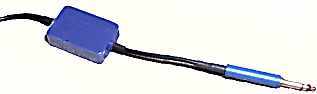
A stereo limiter fitted in a headphone lead
The limiters are can be adjusted to suit different types of earphone. The circuits are driven entirely by the signal and use no battery or external power - so fitting a limiter has some effect on both the sensitivity and the impedance of the earphone. Most types of earphone can be accommodated.
Like other safety devices, limiters should not be fitted or adjusted without specialist knowledge and the right test equipment.
In recent years some large manufacturers of headphones have produced models that include some form of level limiting. Some of these can be useful, but if they are produced for the domestic market they might not protect to the extent legally required for people who are at work.
What are earphones?
"Earphone" is the general name for transducers that make sounds either close to the ear or actually in the ear canal. So on this web site, 'earphones' can refer to headphones, headsets, or in-ear devices such as hearing aids.
Copyright © Tony Woolf 2000 & 2010